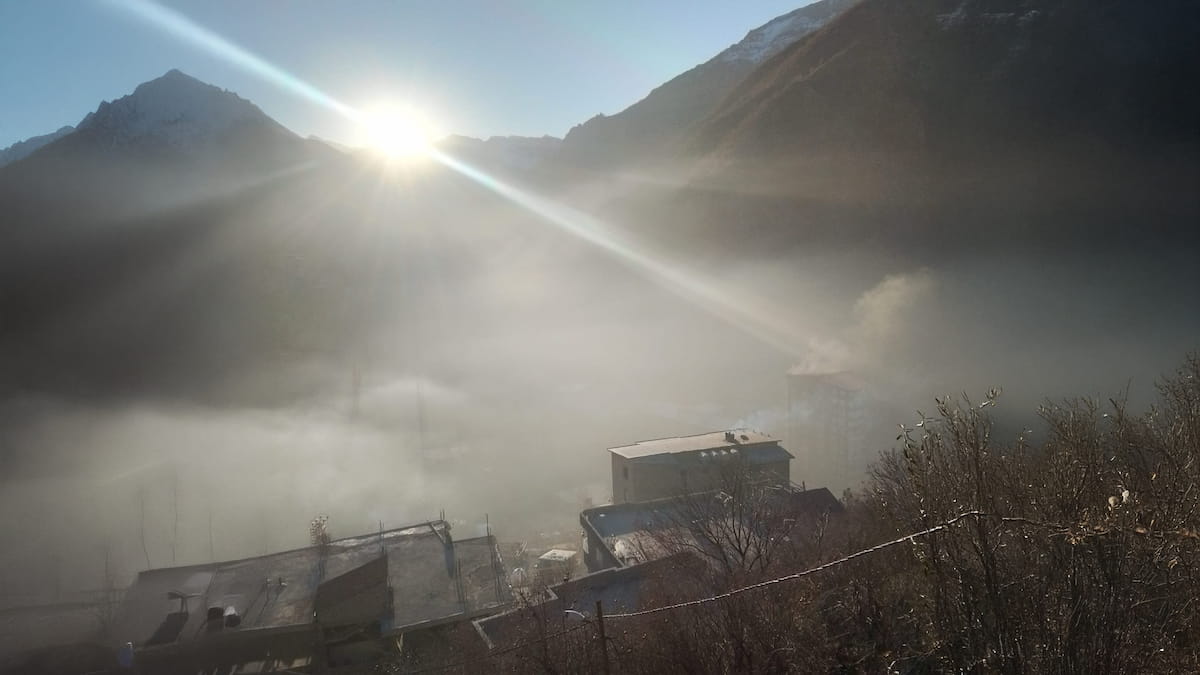
Şırnak province is one of Turkey's most polluted, with over 250 unhealthy air days per year. The provincial PM10 annual average of 81 µg/m³ (2019) exceeds the WHO guideline value by 5.4 times, while Uludere's deep valley geography is highly conducive to trapping pollutants due to thermal inversion. The largest point source of pollution in the region, the Silopi Thermal Power Plant, burns asphaltite with high sulfur (4–7%) and ash (35–40%) content, emitting over 2 million tons of CO₂ annually along with heavy metals (nickel, vanadium, cadmium, uranium). There is no air quality monitoring station in Uludere — meaning the lack of data is itself a serious problem.
Section 1: A district trapped at the bottom of a valley — Uludere's geography
Uludere (known as Qilaban in Kurdish), located 48–50 km from the Şırnak provincial center at approximately 37.43°N, 42.86°E coordinates. The district center sits at 1,220–1,230 meters elevation, positioned in a deep valley bisected by the Kılaban Stream. The district covers a total area of 825–841 km² with a 56 km Iraqi border to the south. Elevation ranges from 800 meters in Şenoba town to 3,200 meters at Kel Mehmet Mountain (Kêla Meme).
Key data: District center elevation 1,230 m, district area 841 km², province's highest point Altın Mountain 3,358 m, Cudi Mountain 2,089 m.
The Southeastern Taurus mountain system, which dominates Şırnak province's general geography, makes the region extremely rugged. The Tigris River forms the province's most important waterway, while Hezil Stream and the connected Kılaban Stream form Uludere's hydrological backbone.
Uludere's climate is continental: summers are hot and dry, winters are long, cold, and snowy. The annual temperature range varies between approximately -4°C and 32°C. Annual precipitation across Şırnak province is 633–806 mm, concentrated primarily in winter and spring months.
Critical impact of valley geography on air quality
Uludere's geographical structure harbors "worst case scenario" conditions for air pollution. The thermal inversion mechanism, well-documented in atmospheric science, is the primary cause of pollutant concentration in valley settlements.
What is thermal inversion? Under normal conditions, temperature decreases with altitude and warm air rises, dispersing pollutants. However, especially on clear winter nights, cold dense air settles to the valley floor; surrounding mountains block wind and a warm air layer above acts as a "lid" preventing vertical mixing. Pollutants become trapped at the valley floor.
A peer-reviewed study conducted in Salt Lake City (Beard et al., 2012, Environmental Health Perspectives) documented that daytime inversions occurred on 57% of winter days, during which NO₂ increased by up to 49% and PM2.5 by up to 54%. Uludere's valley, described as "so narrow the sky cannot be seen," combined with snow-covered ground, cold winters, and solid fuel use, is extremely prone to such inversion events.
Warning: No air quality measurement data specific to Uludere has been found. This represents a serious monitoring gap.
Dams in the region and microclimate potential
Ilısu Dam (Prof. Dr. Veysel Eroğlu Dam and HEPP), reached full capacity on the Tigris River in 2020, with a height of 135 meters, 10.6 billion m³ reservoir volume, and 1,200 MW installed capacity. Turkey's 3rd largest reservoir lake with a 309 km² water surface could theoretically create microclimate effects such as moderating temperature extremes and increasing humidity in the nearby area; however, no scientific study on this has been published.
Cizre Dam was licensed in 2023 with 340 MW capacity and is under construction; with 381 million m³ reservoir volume, it plans to irrigate 76,591 hectares in the Nusaybin-Cizre-İdil plains.
Section 2: Şırnak's air — over 70% of the year is unhealthy
An air quality monitoring station operates at Şırnak provincial center under the National Air Quality Monitoring Network (UHKİA), affiliated with the Ministry of Environment, Urbanization and Climate Change. This station primarily measures PM10 and SO₂. There is no air quality monitoring station in Uludere.
Şırnak PM10 data by year: In 2019, PM10 annual average of 81 µg/m³, Turkey's 4th most polluted province (source: PMC). In 2021, 5–8 times WHO levels, again 4th most polluted (source: Kara Rapor 2022). In 2023, in the top 10, 8th most polluted (source: Kara Rapor 2024). In 2024, over 250 unhealthy days, among the worst (source: Kara Rapor 2025).
In 2019, Şırnak's PM10 annual average of 81 µg/m³ is 5.4 times the WHO's 2021 guideline value of 15 µg/m³. It even exceeds Turkey's own national limit of 40 µg/m³ by more than double.
The situation with SO₂ is also serious: in 2023, Şırnak was one of only 6 provinces exceeding national SO₂ limit values. PM2.5 is not systematically measured in Şırnak — Turkey does not even have a legally binding limit for PM2.5 nationwide. However, according to Kara Rapor 2024, Şırnak ranks 3rd in Turkey for PM2.5-attributable death rates, after Hakkari and Batman.
WHO 2021 guidelines vs Turkey comparison
- PM2.5 annual: WHO 5 µg/m³, Turkey has no limit
- PM2.5 24-hour: WHO 15 µg/m³, Turkey has no limit
- PM10 annual: WHO 15 µg/m³, Turkey 40 µg/m³ (2.7x gap)
- NO₂ annual: WHO 10 µg/m³, Turkey 40 µg/m³ (4x gap)
- SO₂ 24-hour: WHO 40 µg/m³, Turkey 125 µg/m³ (3.1x gap)
- O₃ 8-hour: WHO 100 µg/m³, Turkey 120 µg/m³ (1.2x gap)
Turkey's national standards remain far above WHO guideline values. Only 13 provinces even meet the national PM10 annual limit — and even these "cleanest" provinces exceed WHO values by at least 2.7 times.
Section 3: Silopi Thermal Power Plant — Turkey's only asphaltite-fueled energy facility
Technical profile of the facility
Şırnak-Silopi Thermal Power Plant is operated by Silopi Elektrik Üretim A.Ş., owned by Ciner Group (85% Ciner Energy, 15% GSD Holding). It is located between the villages of Görümlü and Çalışkan in Silopi district, at the foot of Cudi Mountain.
Key data: Total installed capacity 405 MW (3 × 135 MW), total investment approximately $800 million, annual average generation 1,795 GWh, direct employment approximately 1,000 people.
The first unit was commissioned in May 2009, the last unit in December 2015. The manufacturer is China National Machinery Engineering Corporation (CMEC). The facility is Turkey's only asphaltite-fueled thermal power plant and operates with Circulating Fluidized Bed (CFB) technology.
Asphaltite: extraordinarily high sulfur and heavy metal content
Asphaltite is a petroleum-derived natural solid hydrocarbon with properties different from coal. The asphaltite used in Silopi has a calorific value of 5,500–5,800 kcal/kg — higher than most Turkish lignite. However, its pollution profile is extremely concerning:
- Sulfur content: Asphaltite 4–7%, typical Turkish lignite 1–4% — very high SO₂ emissions
- Ash content: Asphaltite 35–40%, typical Turkish lignite 15–30% — very high particulate matter
- Heavy metals: Nickel, vanadium, cadmium, uranium, chromium, selenium — carcinogenic and toxic
- Pyrolysis products: BTX 5–10 g/m³ — benzene is IARC Group 1 carcinogen
Legal violations and unfiltered operation
The plant emits over 2 million tons of CO₂ annually. In WWF Turkey's 2019 campaign, the plant was listed as one of 15 thermal power plants lacking flue gas desulfurization (FGD) systems.
In February 2019, a proposal to extend the deadline for 15 plants to meet environmental obligations by 2.5 years was withdrawn after over 60,000 citizen signatures. However, it was re-legislated in November 2019 with AKP-MHP votes. President Erdogan vetoed this law; however, some plants including Silopi continued operating with "temporary activity certificates."
Since Turkey is not a party to the Aarhus Convention, facility-level emission data is not shared with the public. This makes independent assessment extremely difficult.
Distance to Uludere
The straight-line distance between Silopi Thermal Power Plant and Uludere district center is approximately 75–80 km, while the road distance is 113–119 km. The prevailing wind direction in winter months is from north to south — meaning emissions would be carried from Uludere toward Silopi. However, since fine particulate matter (PM2.5) can travel hundreds of kilometers, long-distance impact cannot be entirely dismissed. Nevertheless, local sources (residential heating, solid fuel) and valley inversion are likely more determining factors in Uludere's pollution problems.
Local complaints and parliamentary inquiries
"There are young people diagnosed with colon cancer at age 18. There is a cancer case in nearly every household. Fruit trees dried up, peaches disappeared, walnuts became inedible." — Local activist Fadıl Tay, Yeryüzü Association observation report.
DEM Party MP İrmez described the plant as "essentially a death machine" in 2025. HDP MP Hüseyin Kaçmaz, referencing TÜİK data in 2019, claimed 511 deaths in 3 years and 11,000 disabled citizens in the region were linked to the plant's impact.
Section 4: Thermal power plants and cancer — Scientific evidence from Turkey
Muğla region: strongest epidemiological evidence
Data from the three thermal power plant zones in Yatağan, Yeniköy, and Kemerköy is striking. According to Prof. Dr. Sebahat Genç's data (Muğla Sıtkı Koçman University), the cancer diagnosis rate in Yatağan in 2016 was 182 per 100,000, while the Turkey average was 123 per 100,000 — 48% higher.
Key data: Cancer rate in Yatağan 48% above Turkey's average. Cancer increase after plant operation in Afşin-Elbistan 8-fold. Estimated premature deaths in Muğla (1982–2020) 68,300. Dried red pine forest in Muğla 35,000 hectares.
Afşin-Elbistan: 8-fold cancer increase
After Afşin-Elbistan A plant became operational in 1984, cancer cases referred from the region to Ankara Oncology Hospital increased from 10–12 per year in the 1980s to 59 in 1989 (the plant's 5th year) and an average of 80 per year in the 1990s. The Ministry of Health Cancer Control Department Head shared publicly in 2002 that they expected a "cancer explosion" in the region.
Global scientific literature
Lin et al.'s study covering 83 countries (2019, Environmental Health) revealed that increases in per capita coal capacity were associated with 5.68% higher lung cancer risk. US studies have documented significantly higher hospitalization rates for asthma, acute respiratory infections, and COPD among populations living near fuel-burning power plants.
Specific risks of asphaltite combustion: Chromium(VI) in asphaltite ash is an IARC Group 1 carcinogen. Cadmium carries kidney damage and cancer risk. Due to uranium content, radon gas leaking from ash storage areas transforms into radioactive polonium-210 and lead-210. Benzene released during pyrolysis is an IARC Group 1 carcinogen. The specific composition of Şırnak asphaltites creates a pollution profile different from and potentially more dangerous than lignite combustion.
Section 5: Cumulative impact on agriculture and environment
Soil contamination documented around Silopi
A 2023 academic study published in the Turkish Journal of Nature and Science examined heavy metal accumulation at different distances and depths in agricultural soils near Silopi Thermal Power Plant. The study confirmed that emissions from plant chimneys showed accumulation in surrounding soils.
A global study published in Nature/Scientific Reports (2017) revealed that 79% of vegetable samples and 67% of grain samples near coal-fired plants exceeded food safety standards.
"Since the plant started, our trees dried up, our peaches disappeared, our walnuts became inedible. The insides of figs and pomegranates turned black." — Silopi region farmers, Yeryüzü Association and press reports.
Pollution accumulation through snow and precipitation
In mountainous regions like Uludere that receive heavy snowfall during winter months, SO₂, heavy metals, and polycyclic aromatic hydrocarbons (PAHs) from asphaltite combustion can accumulate in snow cover through wet deposition (snow/rain) and enter water sources during spring melting.
Acid rain mechanism: SO₂ and NOx react with water particles in the atmosphere to form sulfuric and nitric acid. These acids lower soil pH, facilitate the uptake of heavy metals by plant roots, and open the pathway to the food chain.
Turkey overall: economic cost of air pollution
- Turkish population breathing air exceeding WHO limits: 92%
- Annual air pollution-related deaths (2024): approximately 62,000
- Annual economic cost: 138 billion TL
- Annual premature deaths linked to coal plants: 5,000
Section 6: Conclusion — data is insufficient but existing evidence is alarming
The most critical finding of this research is that the lack of data is itself a serious problem:
- There is no air quality monitoring station in Uludere.
- PM2.5 is not systematically measured in Şırnak.
- Facility-level emission data from Silopi Thermal Power Plant is not shared with the public.
- No region-specific epidemiological study has been published.
- The Ministry of Health refuses to share cancer maps for thermal power plant regions.
However, available data paints a strong picture of concern. Şırnak is consistently one of Turkey's 10 most polluted provinces and ranks 3rd for PM2.5-attributable death rates. The asphaltite burned in Silopi is an extraordinarily polluting fuel with high sulfur, high ash, and heavy metal content — and the plant has operated without an FGD system.
Evidence from Turkey's other thermal power plant regions (Muğla, Afşin-Elbistan) shows cancer rates increasing by 48% to 8-fold under similar conditions. Uludere's narrow valley geography has the potential to trap local pollutants during winter inversions.
Urgent recommendations
- Independent air quality monitoring stations must be installed in Uludere (PM2.5, PM10, SO₂, NO₂, O₃, heavy metals).
- A comprehensive epidemiological study must be conducted (cancer incidence, respiratory diseases, birth complications).
- Silopi Thermal Power Plant emission data must be made publicly available.
- Academic studies on the specific health effects of asphaltite combustion must be supported.
- A regular heavy metal monitoring program must be initiated in agricultural soils and water sources in the region.
Key sources
- Right to Clean Air Platform (THHP) — Kara Rapor 2022, 2024, 2025
- Beard JD et al. (2012), Environmental Health Perspectives — Winter Temperature Inversions and Asthma
- Karayiğit AI, Querol X — Mineralogy and Elemental Contents of Sirnak Asphaltite
- Global Energy Monitor — Şırnak Silopi (CİNER) power station
- WHO — Global Air Quality Guidelines 2021
- Lin CK et al. (2019), Environmental Health — Coal-fired power plants and burden of lung cancer
- HEAL (2015/2022) — The Unpaid Health Bill: How coal power plants make us sick
- Human Rights Watch (2024) — Turkey Plans Harmful Coal Power Plant Expansion
- Turkish Journal of Nature and Science (2023) — Heavy Metal Contents in Agricultural Areas Near Silopi Thermal Power Plant
This report has been prepared based on academic and journalistic sources. The data cited reflects information from the respective sources.